We work in collaboration with thousands of local partners and grassroots leaders across the nation who share our commitment to advancing shared prosperity, creating resilient economies, and improving quality of life.
Made up of small towns, mid-sized communities, and urban commercial districts, the thousands of organizations, individuals, volunteers, and local leaders that make up Main Street America™ represent the broad diversity that makes this country so unique.
Looking for strategies and tools to support you in your work? Delve into the Main Street Resource Center and explore a wide range of resources including our extensive Knowledge Hub, professional development opportunities, field service offerings, advocacy support, and more!
Join us in our work to advance shared prosperity, create strong economies, and improve quality of life in downtowns and neighborhood commercial districts.
Jump off the Business Recruitment Train: The Real Returns are in Cultivating Local Entrepreneurship
Historically, whether it’s been traditional economic development or Main Street economic vitality efforts, business recruitment has been an area in which a great deal of our revitalization activities, resources, and capacity were largely allocated. But new research by Main Street America, coupled with emerging trends from COVID-19, suggests greater returns on our missions and resources can be had by transitioning to more deliberate economic vitality work centered on cultivating new business development from within our own communities and neighborhoods. Simply put, we are wasting too much of our valuable capacity and resources on flashy business recruitment marketing gimics and outreach to neighboring small businesses (a zero-sum game) when successful business development for filling vacancies, expanding properties into new uses and functions, etc., lies right under our noses.
New MSA Data Demonstrates Value in Cultivating Local Entrepreneurship
Building on our past survey research focused on the impacts of COVID-19 on small businesses, in August 2020 we conducted a survey aimed at understanding how business owners were managing the recovery from COVID-19. We heard from 2,049 respondents and received a total of 1,414 completed surveys from 47 states plus the District of Columbia. 31 percent of respondents came from communities with fewer than 10,000 residents, and 51 percent of respondents operated businesses that were not in a major metropolitan area. 23 percent of respondents represented businesses with a sole owner-operator, 42 percent had between two and five employees, and 95 percent had fewer than 20 employees.
Relative to entrepreneurship, we asked several questions relating to the intersections of Place and small business creation. A deeper review of this data suggests tremendous significance of Place across business sectors, race, gender, employment size, and location features.
Key MSA Data Findings:
1. Most of your Community Businesses were Started by Local Entrepreneurs and NOT from Outside Recruitment Activities
Overall, 70 percent of local businesses were started by individuals residing in those same communities. And when it comes to businesses located in older commercial districts, like Main Streets, this number increases to 74 percent.
The lowest percentages are found in commercial shopping centers at 52 percent and shopping malls at 50 percent.
Special Note: Businesses that are solely e-commerce are predominately locally launched at 86 percent.
2. Small Scale Producers are the Most Likely Business Type to Start Locally
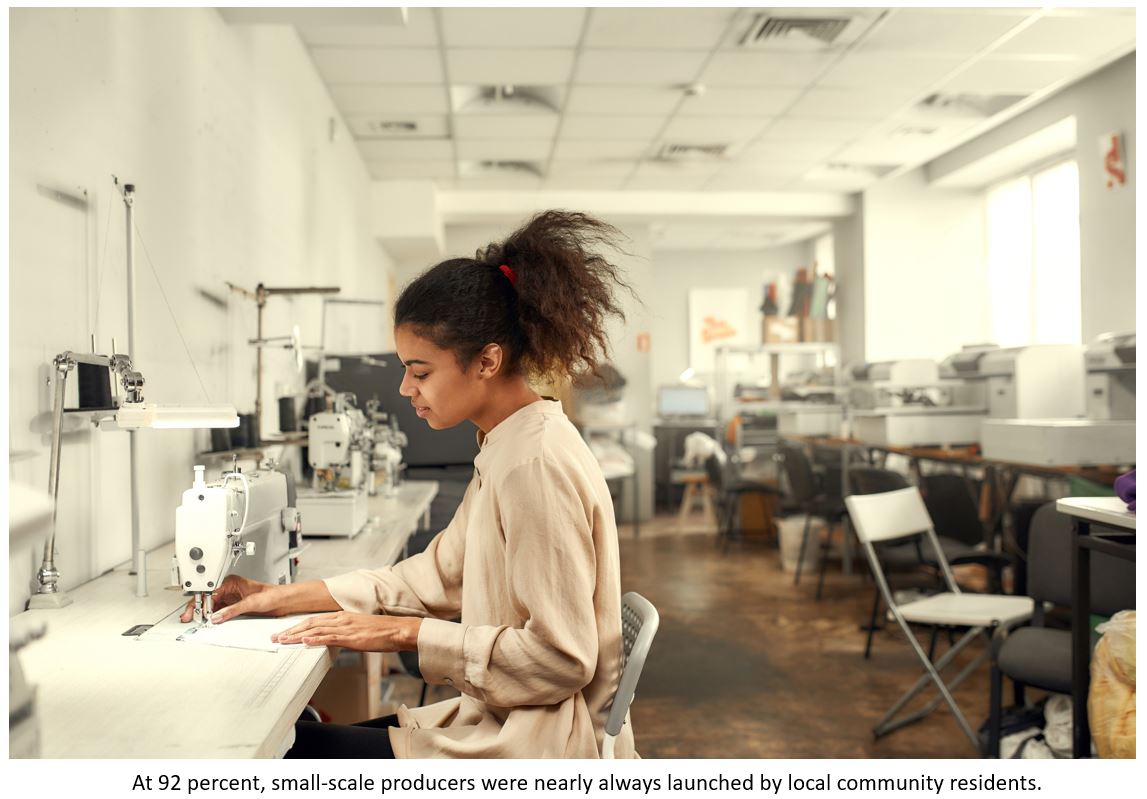
At 92 percent, small-scale producers (like artisans, makers, value-add ag producers, and small manufacturers) were nearly always launched by local community residents.
In addition, local residents were much more likely to be your source of Non-Food Retail and Restaurant-related entrepreneurial ventures as opposed to more service-oriented sectors like Health Care, Accountancy and Legal practices.
3. Your Large Employers Likely Started and Grew from Within: NOT from Business Recruitment Practices
For businesses employing between 11 and 20 employees, 81 percent started locally
For employers of 20 plus employees, 57 percent were launched locally.
4. Businesses Launched by Local Residents Are More Sustainable
Of those surveyed, 73 percent of locally-launched businesses had been in business between 6 and 10 years.
There is some indication that entrepreneurs or existing businesses that move to another community to launch or relocate their businesses have lower rates of survivability after two years. While we heard from many long-operating businesses launched by entrepreneurs who already lived in the community beforehand, we heard from relatively few businesses launched by entrepreneurs who had relocated their business that had been open for more than a couple years. This may warrant some further research.
5. Population Size Demonstrates Differences Between Entrepreneurs’ Residency and Location of Small Businesses
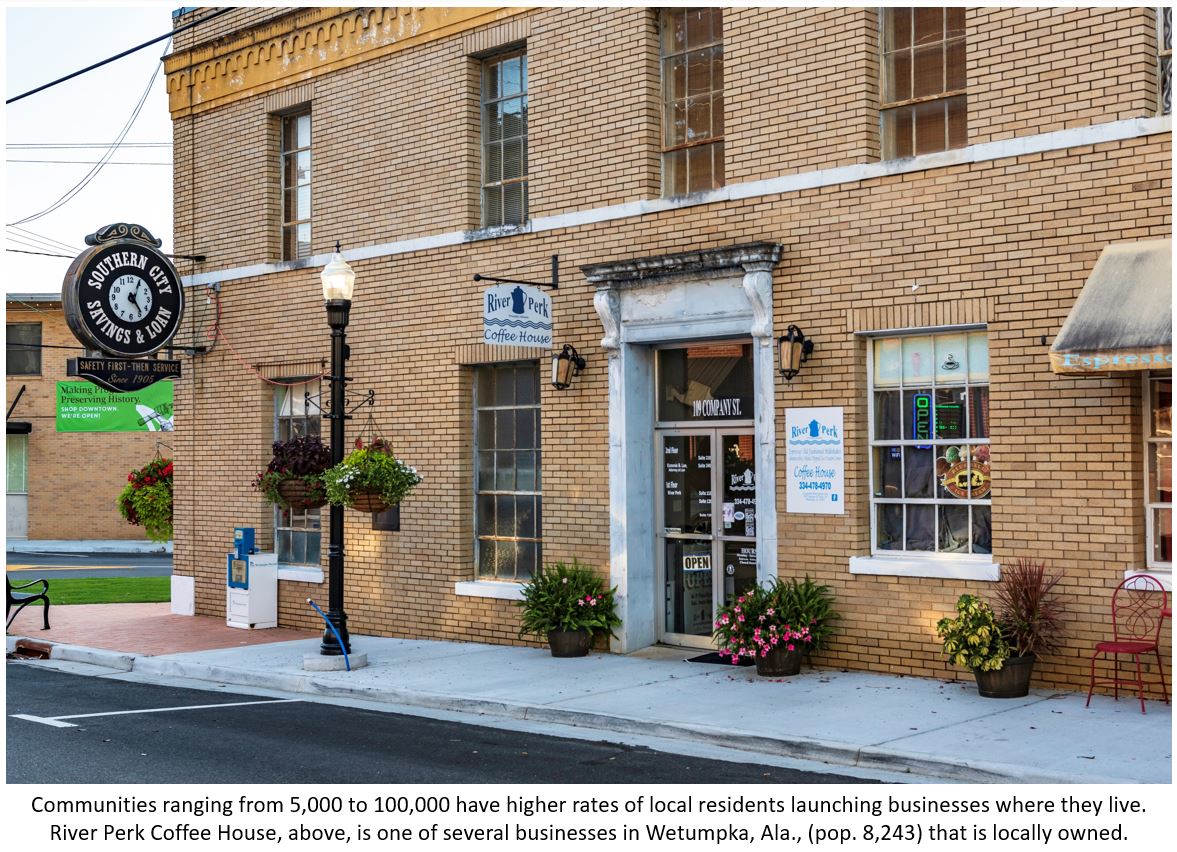
Communities ranging from 5,000 to 100,000 have higher rates of local residents launching business where they live.
Communities smaller than 5,000 tend to have a greater mix of people moving to those locations to start a business, thus suggesting a need for greater balance between supporting local entrepreneurship and creating an attractive business environment conducive to recruiting talented individuals and/or businesses.
Communities larger than 100,000 tended to feature more entrepreneurs living in another area while operating their business in another location, thus not relocating.
Businesses in urban locations were more often started by owners who lived elsewhere.
6. Diversity of the Entrepreneur/Small Business Owner Demonstrate Differences by Location
Survey participants self-identifying as LGBTQ show strong correlation between place of residency and location where they launch their small business at 82 percent.
Asian American, American Indian, and African American respondents were more likely to launch businesses in urban areas, and were more likely to indicate they launched their business in an area away from their place of residence.
Women entrepreneurs (73 percent) are much more likely to launch in the communities/neighborhoods in which they live.
7. Cost is Important but Non-Traditional Place Factors are Strong in Business Location Decisions within Older Commercial Districts
#1 – Affordability
#2 – Location of residence
#3 – Building character
National Trends: The Rise of the ‘Covidpreneurs’
COVID has been responsible for the acceleration of small business closures across the US, with some data suggesting 1.2 million small businesses permanently closed by October 2020, and 19 percent of Black businesses and 10 percent of Latino businesses permanently closed between February and June 2020. To exacerbate the situation, even prior to COVID, the U.S. rate for business creation was at a 40-year low.
As highlighted in a previous blog post in June 2020, we predicted that entrepreneurial growth rates would increase during and post-COVID. This not only has proven to be correct, but frankly beyond expectations as to the pace of growth in entrepreneurship rates.
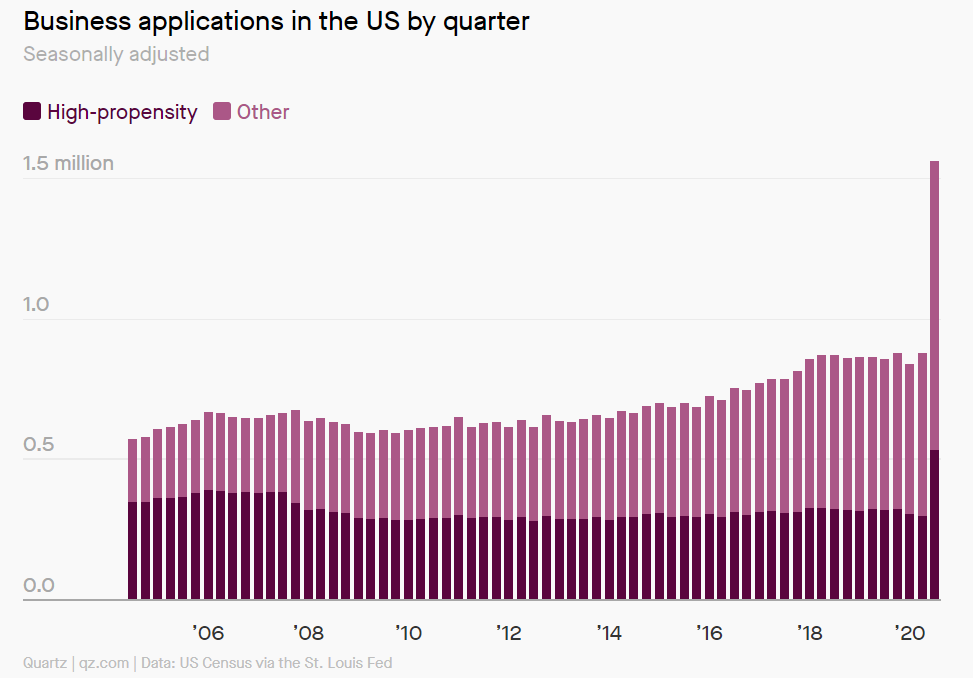
A November 2020 analysis of business applications by the U.S. Census Bureau revealed a massive increase in new business application filings by so-called "high propensity businesses" (those planning to hire, pay wages, and formally incorporate) as well as other smaller and more informal businesses like microventures or "side hustle" entities.
This data represents a 77 percent increase from Q2 to Q3 and a year-over-year increase of 3.2 million by September 2020, a 500,000 increase over the same point in 2019.
The rise in these ‘covidpreneurs’ has been largely fueled by three critical factors:
High unemployment filings (and long-term unemployment)
Cheap money (low interest rates) coupled with high home equity as housing market remains incredibly strong
Low barriers to entry: Business closures represent less competition, and cheap e-commerce platforms, real estate, etc. allow for access.
Transitioning Economic Vitality Recommendations
1. Pivot from Business Recruitment to Local Entrepreneurship Cultivation Our data demonstrates that spending scarce resources on flashy marketing campaigns designed to convince a business to move to your commercial district gets a bad return on investment when compared to pivoting capacity and resources toward mining your community’s nascent entrepreneurs. Share the data with your boards, local economic development stakeholders and entrepreneurship service providers. And as you’re planning for 2021, realign resources to increase efforts in this area of Economic Vitality.
2. Understand the Level of Entrepreneurial Activity Within Your Community Reach out to your local or regional entrepreneurship service providers to understand the current state of small business creation in your community. What are they seeing? What business types are most prevalent? What is the make-up of most of the emerging entrepreneurs? What is the cross-section between bricks and mortar, bricks and clicks, and e-commerce only businesses?
Conduct a search on Etsy to better understand the climate for makers, artisans, and small-scale producers. Within Etsy’s product categories, you can search by zip code to get a feel for the level of this activity within your area, thus also providing a list of potential targets.
And finally, reach out to your city and/or state to inquire about business permit data and levels of new business incorporations to better understand how your community compares with national data trends.
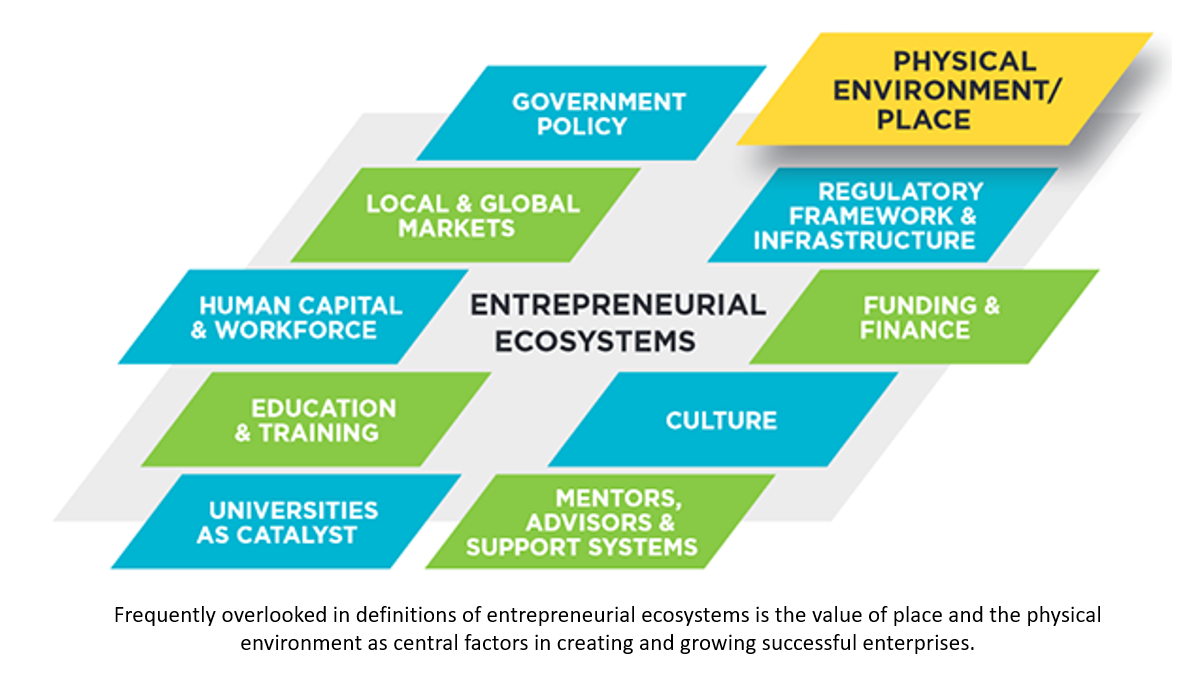
3. Become an Ecosystem Builder A great resource for those new to supporting entrepreneurs and ecosystem building is the work coming out of the Ewing Marion Kauffman Foundation. The foundation’s website features a wealth of information and resources on supporting small business creation. Each year they also host a conference gathering of local ecosystem builders called E-Ship. The latest version 3.0 of their Ecosystem Building Playbook can be downloaded for free from this site.
4. Launch an Entrepreneurship Ecosystem Building Program Main Street America and UrbanMain have developed a suite of technical services and downloadable resources to help guide downtown and neighborhood commercial district programs through the process of collaborating with local entrepreneurs and support providers to outline functioning ecosystems. Refer to our publication, Entrepreneurial Ecosystems and the Role of Commercial Districts, as a starting piece to learn more about your role in supporting entrepreneurs and the importance of Place as a component of a well-functioning ecosystem. In addition, we developed an Entrepreneurship Ecosystem Audit Tool to better evaluate your strengths and gaps, and most importantly how your place-based organization “fits” within the system.
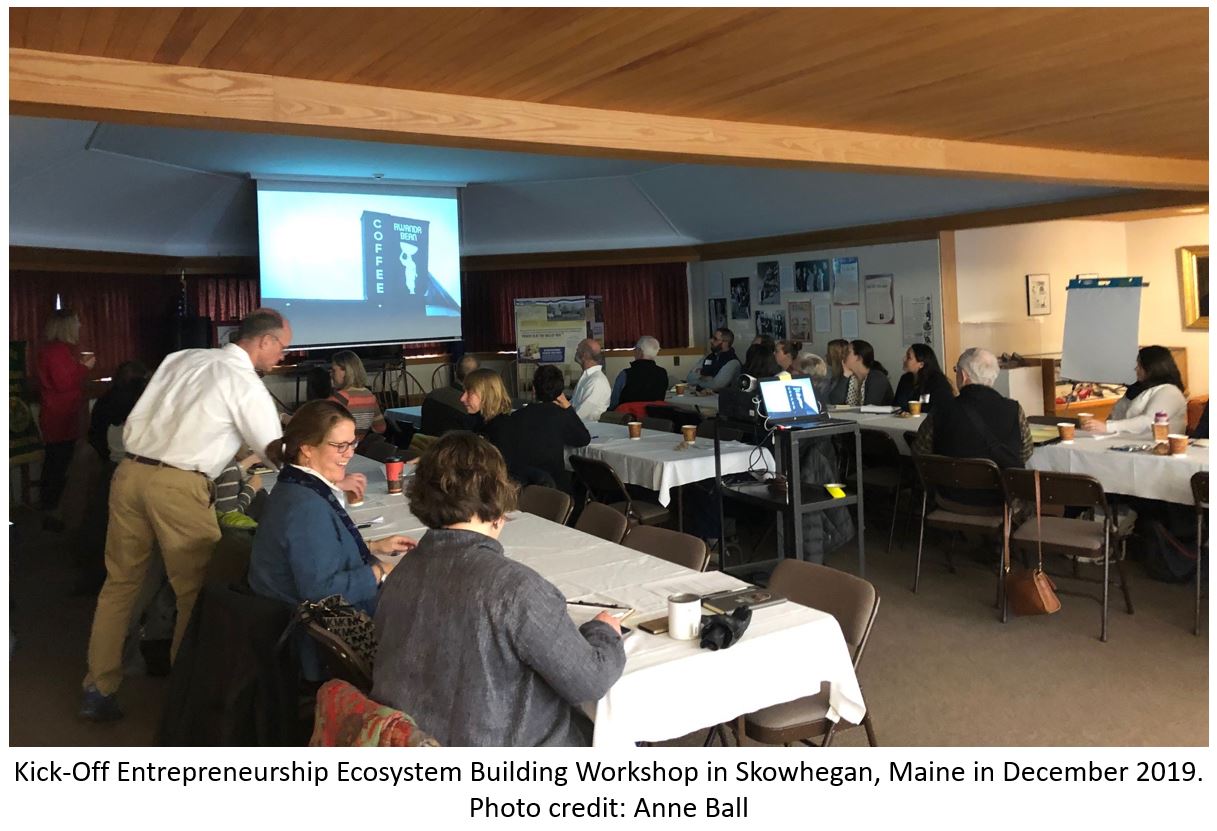
5. Reach out to Us for Technical Assistance If you are interested in learning more about our technical assistance offerings in this area, please reach out. We are currently supporting communities in this work through online engagements and virtual service offerings. We are currently engaged in several projects in Maine, California, and Chicago.
Summary
A robust Economic Vitality effort is key to a comprehensive revitalization of America’s downtowns and neighborhood commercial districts. A breadth of activities focused on business retention, real estate development, financial tools for business and property development—and yes, recruitment—are critical to COVID recovery. However, in the broader scope of economic development, we’ve seen far too much investment in business recruitment efforts and not enough data-driven resource and capacity development in mining our own local talent pool of entrepreneurs. Main Street America’s most recent data analysis coupled with national data trends in business creation suggest a much higher return on program investments is possible by simply reallocating some of those recruitment resources to local and regional entrepreneurship ecosystem building.
Learn how entrepreneurs and neighborhood leaders throughout Miami are breaking barriers through the B3 initiative, preserving cultural roots while shaping opportunities for the next generation.
Chandra Teddleton, Ph.D., shared how the Sweet Auburn Historic District is preserving Black history while creating opportunities for a vibrant and sustainable economic and cultural future.