We work in collaboration with thousands of local partners and grassroots leaders across the nation who share our commitment to advancing shared prosperity, creating resilient economies, and improving quality of life.
Made up of small towns, mid-sized communities, and urban commercial districts, the thousands of organizations, individuals, volunteers, and local leaders that make up Main Street America™ represent the broad diversity that makes this country so unique.
Looking for strategies and tools to support you in your work? Delve into the Main Street Resource Center and explore a wide range of resources including our extensive Knowledge Hub, professional development opportunities, field service offerings, advocacy support, and more!
Join us in our work to advance shared prosperity, create strong economies, and improve quality of life in downtowns and neighborhood commercial districts.
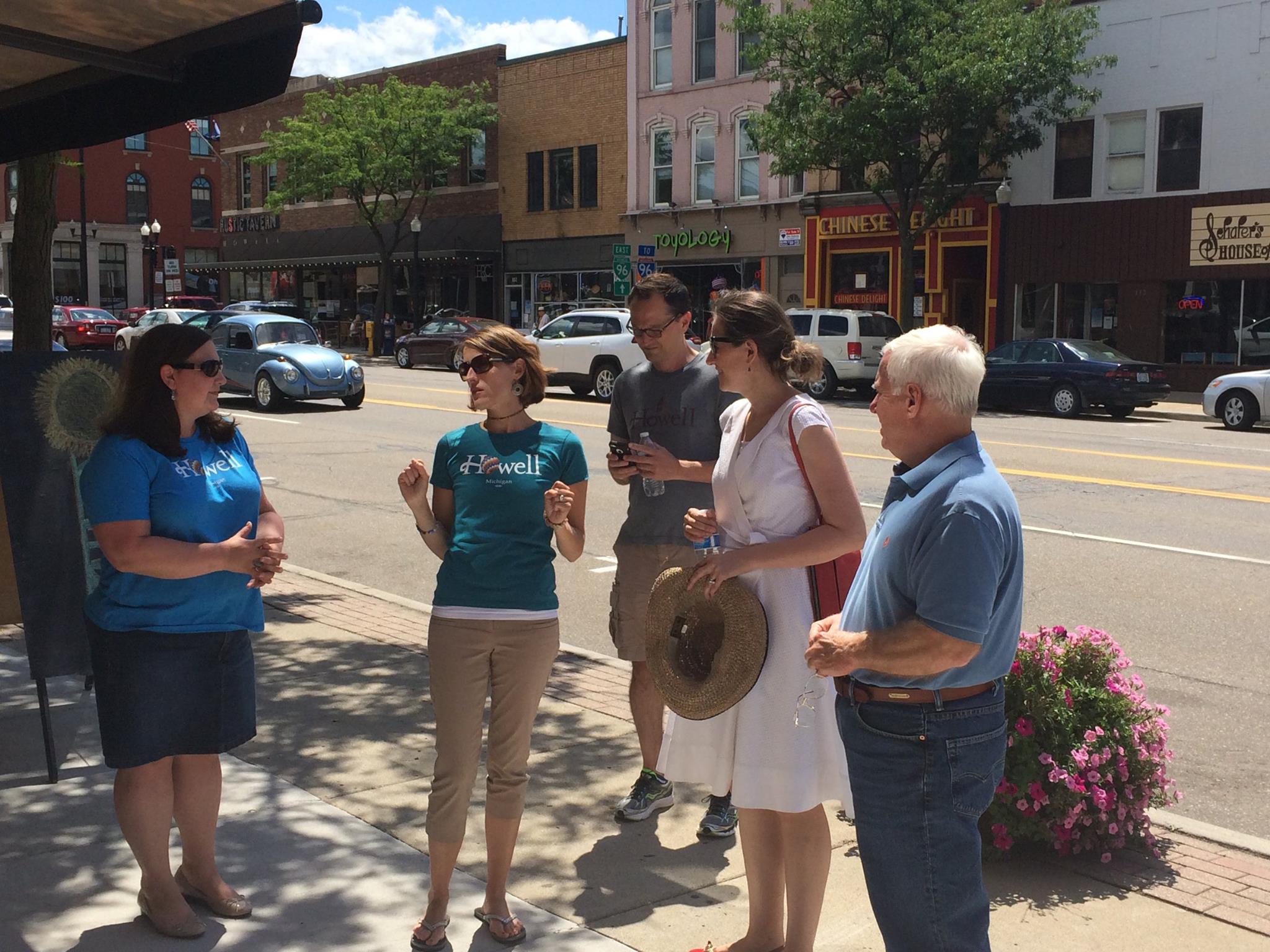
Patrice tours Downtown Howell, Michigan, with Howell Main Street Executive Director Cathleen Edgerly, staff, and Howell Mayor Proctor.
Lately, I’ve come across a few things — a podcast, a magazine article, and a series on a blog — that has me reflecting on a fundamental aspect of our work at Main Street: the power of small steps. When you think about it, the promise of the Main Street Approach is pretty audacious: sustainable, comprehensive transformation of a downtown or commercial district. But, the mechanism for achieving that change is quite simple. A series of small, incremental improvements, when taken together, provide momentum for long-term economic transformation and improved quality of life in a community.
An article in Inc. by Ramit Sethi calls this concept the Domino Strategy. A Freakonomics podcast and a terrific series of blog posts by Chuck Marohn at Strong Towns put it in terms very familiar to those of us at Main Street: incrementalism. Whatever you call it, this “start small” mentality has long been a core facet of the Main Street Approach. But incrementalism is decidedly not flashy, and we don’t talk about its importance as much as we should. I hope we can change that, because what incrementalism lacks in headline-making ability, it makes up for in impact.
For decades, the community and economic development field was hooked on the silver-bullet solution. With tight budgets and big dreams, city leaders sought the “one big thing” that would transform their local economy, whether it was a big new commercial development, a pedestrian mall, or a convention center on the outskirts of town.
But, as Ed McMahon, Senior Fellow at the Urban Land Institute and Chair of our Board of Directors, likes to say, successful economic development focuses on what a community has, rather than on what it doesn’t have. That means being laser-focused on the small things that make your community successful, and leveraging those things to make lasting change.
We at the National Main Street Center have big goals — for our organization, and for the Main Street America movement. To achieve those goals, we’ve taken our own advice and started small: investing in new resources and branding, developing new partnerships, and making incremental improvements to the Main Street Approach — things that collectively make our organization and the movement more successful.
Hopefully, you’ve seen and benefited from those "small” things over the past few years. Today, I invite you to explore them on the new digital home for Main Street America.
We hope you enjoy exploring our new website, and encourage you to continue to check back for new features. Just like on Main Street, we’ll continually be improving and adding to mainstreet.org in the months and years to come.
Main Street Now 2026 in Tulsa, Oklahoma, is sure to be the biggest professional development event for civic leaders looking to boost their impact and role in the success of their local Main Street. And with registration as low as $200, it's an unbeatable opportunity.
Dionne Baux shares how Historic King Drive BID's executive director Ray Hill is leading the district to success by supporting strong economic sustainability.
Rooted in Main Street fundamentals and informed by feedback from across the network, the 2026 schedule is full of opportunities to exchange ideas, tackle real challenges, and gain practical tools to help communities stand strong for generations to come. Get a peek at new sessions, revamped favorites, and role-based learning tracks.